http://www.ckrz.com/webpage%20news.pdf The Federal Court has green-lighted a legal challenge of Indian Affairs Minister Chuck Strahl's intervention in a nasty leadership dispute on a Quebec reserve. Judge Russel Zinn set aside Tuesday an earlier ruling that struck down an application to judicially review Strahl's exclusive support of a new chief at Barriere Lake. The tiny community about 300 kilometres north of Ottawa has drawn riot police to the scene of road blockades over leadership and forestry disputes stretching back more than a decade. At issue in this case is the decision by Strahl's department last Jan. 31 to recognize and “conduct its relationship” with Chief Casey Ratt and four councillors. Ratt is accused by his detractors of breaching the band's customary election code and deposing interim chief Benjamin Nottaway. Nottaway was recently sentenced to 45 days in jail for his role in related protests that blocked part of Highway 117 outside the impoverished reserve of about 450 people. Ratt has publicly dismissed the so-called leadership crisis as the sour grapes of failed leaders who are no longer in charge. He says he first agitated for a leadership review last year after Nottaway's backers shut down the band school. Ratt has accused his rivals of using local kids as pawns in a complex political battle with the province and Ottawa. It includes a protracted fight for a share of forestry and other resource revenues estimated to be worth $100 million a year on traditional Algonquin territory. Ratt's house burned down in a manner he describes as suspicious, and he has accused his opponents of trying to bully him off the reserve. His challengers, led by the elders council of Barriere Lake, now want a court review of Ottawa's support for his leadership. The Federal Court decision Tuesday paves the way. “In my view, it is open to the applicants to argue that (Strahl), when he decided that in dealing with (Barriere Lake) he would deal with the Ratt council, made or purported to make, a decision under the Indian Act” that is “reviewable,” Zinn ruled. The elders council and Indian Affairs “ought to be permitted to make full submissions to the court on all of the issues raised in the application,” he wrote. David Nahwegahbow, lawyer for the elders council, said the ruling is “quite a relief.” “The minister tried to say that basically they didn't make a decision, that all they did was sort of receive the (leadership) results and put them in the filing cabinet. That was pretty bogus. “What I thought was quite dangerous was that the minister made a decision as to who he would conduct his relationship with. And if you . . . analyze the implications of it, basically then the minister could decide who he wanted to deal with in terms of . . . setting up a treaty or making any kind of an agreement.” It was not immediately clear whether Strahl would appeal the Federal Court decision. “Because it's still before the courts it would be inappropriate to comment,” said Patricia Valladao, a spokeswoman for Indian Affairs. (The Canadian Press)


Algonquins upset by police behaviour
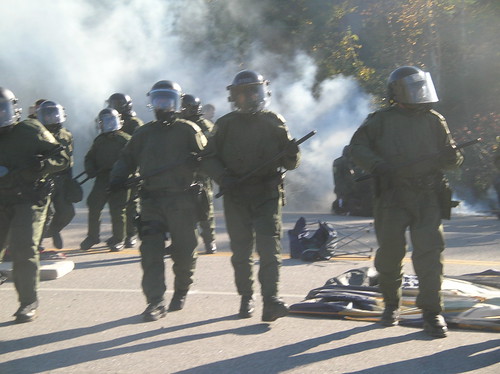
Sûreté du Quebec breaks up aboriginal highway blockade
Dave Rogers, The Ottawa Citizen
Published: Wednesday, October 08, 2008Quebec police fired teargas or some kind of irritant at children and attacked elderly demonstrators when they cleared an aboriginal blockade on Highway 117 north of Maniwaki, Barrière Lake Algonquins said yesterday.
The Sûreté du Québec charged nine people, including two juveniles, with mischief yesterday after officers cleared a pile of logs from the highway that links the Outaouais to the Abitibi region.
Police released the accused on condition that they keep the peace.
Sgt. Melanie Larouche said police fired canisters containing a chemical irritant, not teargas at the crowd. She said paramedics determined afterwards that no one was injured.
The blockade began at 6:30 a.m. and police began removing the protesters and barricade from the highway at about 4 p.m.
Michel Thusky, a spokes-man for the Barrière Lake Algonquins, said police fired canisters into the crowd of 74 adults and about 40 children after reporters left the blockade.
The band said the police roughed up a 59-year-old woman when they removed protesters and an Algonquin man in his 20s struck by a canister was treated in hospital for neck burns yesterday.
Martin Lukacs, a volunteer who works for the band, said children were on the highway because the blockade was a community event and the Algonquins did not expect a violent confrontation. He said the police struck while the children were eating.
The Algonquins of Barrière Lake want the Indian and Northern Affairs Department to recognize their traditional council and chief and a federal-provincial treaty that would give them a share of natural resource profits on their land.
The unemployment rate in the community of 650 people, 300 kilometres north of Ottawa, is about 90 per cent.
In 1991, the Barrière Lake Algonquins signed an agreement with Canada and Quebec to sustainably develop its 10,000-square-kilometre territory. Since 1996, the federal government has recognized a minority group and chief that oppose the agreement.
Mr. Thusky said a police riot squad damaged tents and the children's tables.
"They tossed teargas into the crowd that hit our children right after the media left," Mr. Thusky said. "The police just ignored the presence of the children, elderly people and the disabled.
"We piled logs and six barrels on the road and put out food for the children and the elderly. The riot squad threw our beaver meat and other traditional food on the ground when they moved in, which is not respectful."
Mr. Thusky said the Algonquins will continue demonstrations to convince the federal and Quebec governments to honour an agreement with the band to manage the land co-operatively.
He said the Algonquin community doesn't receive any benefit from the millions of dollars earned each year from forestry, electric power generation and sports hunting on Barrière Lake land.
Indian and Northern Affairs has recognized the new band council headed by Chief Casey Ratt, whose house burned down in the spring under suspicious circumstances.
The previous band council, headed by former acting chief Benjamin Nottaway, has the support of the Algonquin Nation Secretariat and the Union of British Columbia Indian Chiefs, which accused Indian Affairs of supporting a coup in the community.