My Canada includes rights of Indigenous Peoples.
Love it or leave it! Peace.
Showing posts with label Residential schools. Show all posts

Monday, December 27, 2010

Aim of 'residential schools' was to get the land ... "One day the north will be strong and free..." Date: November 02, 2008 05:13PM
http://www.nunatsiaq.com/discussion/read.php?1,4287,4288#msg-4288
The true aim of the Indian residential schools was not to destroy the Indian in every child, as the governments continue to keep on claiming. It was just a ploy. The true aim of the Indian residential school system was to get the land of the native peoples, that was all they were intended to do, and it had worked remarably well. The Inuit of the eastern arctic had not really been included in the residential school fiasco until the end of the 1950's. The Inuit at that time had been sent to hostels in a few communities, this was for the Inuit of Quebec. The government had to work extremely fast in the beginning of the 1960's to ship young Inuit children to the one main residential school located at Churchill, anarq, because talk about residential schools were beginning to surface in southern Canada at that time. So the federal government worked on the scheme of Ralph Ritcey, who was just another englishman pedophile, to make the former army base in Churchill into a residential school. The government worked fast, extremely fast so that they could destroy our strong cultural and family ties just before they were done away with. The government had just this one chance to divide us up and seperate us from our families for long periods of time. The Churchill Vocational Center opened it's doors in 1964 and closed in 1973. And negotiations for the land started in 1973, makes sense? And negotiations for the land started in Nunavut shortly thereafter. The governments have almost gotten away with the crime of the century, which was to obtain my land by whatever means available. But just wait here one minute everyone, I am not finished yet. I have not surrendered or signed away of my rights or title to my land, nor some of my people, so in fact I still retain my rights to the land that my grandfathers and father had seen and walked on, I still do. And the unauthorized developments that have been taking place on my land have been going without my consent. And if the people who have not signed away their rights to their land on which their fathers walked and lived on decide to do so, we can kick out the developers of my land by force. It is still my land, and if I decide to do so, I can still make a claim for the whole territory north of the 55th parallel in northern Quebec, now known as the Kativik region. I am not finished yet, the Indian in me is not yet destroyed, in fact it has just gotten more stronger, and my resolve to right this horrible wrong has just gotten stronger as well. One day the north will be strong and free but for now someone else is taking care of it for my people and the job is being very poorly done. One day I will get my land back, one way or another, either through peace or force.
*****
Egerton Ryerson described his mandate for the 1847 report commissioned by Ontario, wherein he recommended that the government run the 'Indian' Residential Schools:
"There is a need to raise the Indian to the level of the whiteman, and take the land out of Indians hands."

Sunday, January 18, 2009

APOLOGY DEMANDED FOR US NATIVE BOARDING SCHOOLS A recent editorial by Native journalist Tim Giago presents his viewpoints about the need for the story to be told about widespread abuses at early US Indian boarding schools and to call for a national apology:
http://www.mcclatchydc.com/337/story/59583.html
In addition, there are several movies/documentaries just released or slated to be released about the boarding school experience, including the new Wes Studi movie, "The Only Good Indian" (http://www.theonlygoodindian.com ) to be shown this weekend during the Sundance Film Festival in Utah.
The Elders also say the time is right for a collective healing from the trauma of the schools. This year, White Bison is hosting its fifth Sacred Hoop journey, the Wellbriety Journey for Forgiveness (formerly The Way Home Tour), to promote awareness of and healing from the historical trauma carried home from US Indian boarding schools.
The 40-day, 6,800-mile Journey begins May 16, 2009, at Chemawa Indian School in May 16 at the present-day Chemewa Indian School in Salem, Ore., and ends at the site of first Indian school at Carlisle, Penn., established in 1879.
At the conclusion of the Journey, a petition will be presented in Washington D.C. calling upon the President of the United States to formally apologize for abuses at the schools. Please visit www.wellbrietyjourney.org to sign the petition, find out how you can help and learn general information about the journey.
Please join White Bison in support of a collective healing from the historical trauma of the Indian boarding schools.

Commentary: 'Cultural Genocide' in the Land of the Free
It would appear to me that most Americans know more about the "Stolen Generation" of Aboriginal children in Australia than they do about the "Stolen Generations" of Indian children in their own country.

Why is that? Well, movies such as "Rabbit-proof Fence" and the newly released film "Australia" probably have something to do with it. In "Rabbit-proof Fence," two little aboriginal girls are taken from their homes to the Catholic mission boarding school without the consent of their parents. They run away from the school and follow the path of the rabbit-proof fence hundreds of miles knowing that the fence runs next to their land and will lead them home. The fence was designed to contain the proliferation of rabbits that had begun to overrun Australia.

The movie "Australia" contains some key roles for the aboriginal people. The main focus is on a small boy who barely escapes the hands of the police early on in the movie only to be captured in the end and sent to the island mission school that is designed to "breed the black" out of the aboriginal children.

It wasn't until 1973 that the practice of taking aboriginal children and placing them in mission boarding schools was prohibited by law in Australia. There has never been a law passed in America to end the same practice. In the 1960s the government-backed practice of taking Indian children from their parents and placing them in Bureau of Indian Affairs and Christian missionary boarding schools began to end of its own volition.

In Australia and in America the children were taken from their parents and their homelands to "breed the black out of them" and in America they were taken to "breed the Indian out of them." The saying popular in the hierarchy of the Catholic Church and in other denominations, as well as in the halls of Congress, was "Kill the Indian, Save the Child."

This practice, though well-intended by those implementing it, did more damage to the American Indian children than any other. What started out as a practice to convert the children to a new religion and a new perspective turned out to be nothing more than "cultural genocide."

An abundance of lawsuits against the Catholic and Anglican churches resulting in victories for indigenous complainants in Canada and Alaska have received little or no attention in America.

A recent lawsuit against the Catholic Church by former students of the St. Francis Indian School on the Rosebud Indian Reservation is now in the courts. There are statutes in South Dakota that would consider a statute of limitations and also consider allegations other than sexual abuse as non-essential. If "cultural genocide" could be included in the number of reasons for the lawsuits in South Dakota, it would put an entirely new face on the process. Though many former students still sport the scars of the sexual, physical and psychological abuse of the Indian boarding schools, the attempts to destroy their cultural beliefs is just as damaging and just as significant. The collateral damage of "cultural genocide" is one of the intangibles that are not easily interpreted in a court of law. It has taken nearly a generation for the former students of the Indian boarding schools to finally step forward and openly speak of their sexual abuse. It is not in the culture, the very culture that the boarding schools attempted to erase, for these Indian people to do so.

But after two or three generations, they are, at last, stepping forward and sadly, their courageous stand is drawing criticism from many of their own "converted" people. These are the converts that went through their entire boarding school experience apparently wearing blinders because they failed to see the abuse, whether it was physical, psychological, sexual or cultural that was taking place all around them.

These converts are as much a part of the cover-up as are the movie producers in Hollywood that find these true-to-life situations of cultural genocide too powerful and embarrassing for the consumption of the general population of Americans.

If Australia can finally stomach these epic wrongs against the aboriginal people of its continent and actually produce films depicting these evils, one can only ask the question: Where are those American film producers with the same courage? And if the government of Australia can issue an official apology to its aborigine citizens for the evil it rained upon them, why can't the America government do likewise? What is needed is an American Indian Spike Lee or a David Wolper to tell America "the rest of the story."

ABOUT THE WRITER

Tim Giago, an Oglala Lakota, is the founder and first president of the Native American Journalists Association. He can be reached at najournalist@msn.com or by writing to him at P.O. Box 1680, Rapid City, S.D. 57709. His new book, "Children Left Behind," is available at harmon@clearlightbooks.com.

© 2009, Tim Giago

Monday, November 03, 2008

Reconciliation will take time
Commission lays the foundation, say its supporters
MARITES N. SISON staff writer
Nov 1, 2008
contributed
A conference poster shows an image of an Indian residential school classroom.
Montreal Academics who gathered here recently for an international conference on Canada’s Truth and Reconciliation Commission (TRC) have cautioned Canadians against looking at the TRC as the final stage in the reconciliation with aboriginal people harmed by the 150-year legacy of forced assimilation through the Indian residential schools. “This (reconciliation) is a process that will take a long time,” said Eduardo Gonzalez, deputy director for the Americas at the International Center for Transitional Justice (ICTJ). “It necessitates looking that scary question straight in the eye: ‘Will we ever trust each other again? Will we all, at some point, overcome our mutual perceptions and see each other as citizens?’” Mr. Gonzalez said the first step in the process of reconciliation is “accepting to discuss the nature of the past crimes and their consequences.” He added that “nobody can be reconciled by decree; similarly, nobody can be forbidden to forgive.” What society can do collectively, he said, is “invite everyone to share a view on what is needed to trust each other and institutions we have created.” Mr. Gonzalez, who served as a commissioner of Peru’s Comision de la Verdad y Reconciliacion (Truth and Reconciliation Commission), was one of more than a dozen academics at Breaking the Silence, a two-day conference on the TRC held Sept. 26 to 27 at the University of Montreal. (Mr. Gonzalez now works for the New York-based ICTJ, which helps societies emerging from repressive rule or armed conflict as well as established democracies “where historical injustice or systemic abuse remain unresolved” deal with issues involving truth-seeking, reparations, criminal justice and reconciliation efforts.) “The TRC should be a step in a much longer process,” said Cynthia Milton, a history professor at the University of Manitoba. “It should act as a wedge that opens up a space to push issues, including taboo truths.” Sue Campbell, a professor at Dalhousie University’s department of philosophy, cautioned against applying the “Western conception of memory,” which dictates that the past must be forgotten in order to move forward. “For the First Nations, the past can’t be forgotten because the past is in the present, and the effects linger,” she said. “Unless we make a connection between past and present, we can’t understand the full harm of residential schools and assimilation.” Several academics said the TRC will be challenged by the varying interpretations of reconciliation. “To what degree do we share the view of reconciliation?” asked Jeff Corntassel, assistant professor at the University of Victoria’s indigenous governance programs. “Is reconciliation possible at all? What do we want? What expectations do we have?” added Christian Nadeau, a professor at the University of Montreal’s philosophy department. The conference also heard that the now-defunct federally-financed, church-run residential schools, which were created to force aboriginal people to assimilate with the dominant culture, cannot be viewed in isolation from issues such as self-determination and land rights. Mr. Gonzalez said that Canada’s Royal Commission on Aboriginal Peoples recognized 12 years ago that “the victimization of children and families in the residential schools was only part of a wider set of policies, seeking to remove aboriginal peoples from their homelands, suppress their nations and governments, undermine their culture and identity.” Mr. Corntassel said that truth-telling “must be bridged by self-determination, justice and restitution.” Reconciliation, he added, “must involve a process of renewing relationships, otherwise it becomes a rhetorical reconciliation.” Mr. Nadeau added that no reconciliation is possible without obligation. He wondered: “How is the TRC’s work going to matter if it doesn’t lead to socio-economic and political change for the aboriginal population?” Several academics also shared the view that criminal justice was a necessary element for addressing the injustice committed against former students; they lamented the fact that the TRC has no prosecutorial powers and has no mandate to conduct a public inquiry. The TRC is part of a revised residential schools agreement which took effect September 2007. It is intended to provide former students and their families with a chance to share their experiences in a culturally-appropriate, safe environment. “Reparation policy that goes beyond a transfer of funds, and incorporates explicit acknowledgment of wrongdoing recognizes the dignity of victims and the responsibility of the state,” said Mr. Gonzalez. “Criminal justice shows that the suffering of victims has not been forgotten, and sends the message that everyone, even the most vulnerable, the smallest among the small, the weakest among the weak will be protected.” Mr. Gonzales said a challenge for the TRC would be how to “remove the veil of silence, but also of euphemism” about the residential schools. He noted that while the government’s apology last June spoke of abuses that took place in the schools, they have been made “in general terms and without clear acknowledgment of the criminal nature of those acts.” Not only are the abuses “unaddressed,” but they also deny Canadians the opportunity to hear about those abuses “in a credible, exhaustive investigation,” he said. “Without an opportunity for the victim to speak directly to the country … weaving their narrative, the abuses will still be seen as probable exaggerations.” Mr. Nadeau asked: “What is the proper role of apology? I see it as part of recognition of wrongdoing. But it is nothing without punitive response to wrongdoing.” Assembly of First Nations national chief Phil Fontaine said, however, that the TRC “was structured not to concede to Canada’s legal framework,” but to adapt to the needs of the former students. “We were thinking of the survivors. The ADR (alternative dispute resolution) experience was painful for them,” said Mr. Fontaine, who spoke at the conference. Kathleen Mahoney, the AFN’s lead negotiator, added that former students “didn’t want a court room setting,” which allows for cross-examination of both complainant and accused. Mr. Fontaine added that most perpetrators of physical and sexual abuse against the students are now dead. “I urge caution, especially to those who see this as limited. It’s not. We support the TRC’s work 100 per cent,” said Mr. Fontaine, himself a former residential schools student, who helped negotiate the Indian Residential Schools Settlement Agreement between the government, churches and former students. “The TRC is so important because once all the money is gone, this will be the lasting legacy,” said Mr. Fontaine, adding that the apology made by Prime Minister Stephen Harper last June 11, “should be seen as a staging point for reconciliation,” while the TRC “is about writing the missing chapter in our shared history.” Commissioner Claudette Dupont-Smith said the TRC is currently looking at various methods for people to express themselves, adding that its work will be guided by a committee comprising former students. ***** Contact: Eduardo Gonzalez, Deputy director for the Americas International Center for Transitional Justice egonzalez@ictj.org http://www.ictj.org/en/where/region2.html The International Center for Transitional Justice (ICTJ) assists countries pursuing accountability for past mass atrocity or human rights abuse.
TRC: Debate grows over whether sitting judges should accept inquiry appointments Janice Tibbetts , Canwest News Service

OTTAWA - An Indian residential schools probe has deteriorated into a mess after the commissioner quit.

The judge who led the federal sponsorship inquiry received a sharp rebuke from the Federal Court. And a public inquiry into an alleged pedophile ring in eastern Ontario has been ordered to a halt because it has dragged on too long.

Canada's passion for public probes has taken a beating in recent months, reviving a dormant debate over whether sitting judges should accept inquiry appointments, particularly when they risk being dragged into the political realm, or relinquish control over the process and jeopardize their independence.

"There are clearly examples, with the wisdom of hindsight, it might have been better if the judge had simply said no," said Richard Scott, Manitoba chief justice and head of the conduct committee for the Canadian Judicial Council.

The recent resignation of Justice Harry LaForme as head of the Truth and Reconciliation Commission on abuse at Indian residential schools should serve as a wake-up call for judges to think twice before agreeing to take part in government-sponsored probes, say legal analysts.

LaForme quit suddenly after citing "incurable structural defects" and the "paralyzing conduct"_of the other two commissioners, whom he denounced for not respecting his authority. He also expressed fear last summer the commission was too closely tied to government and that the other commissioners were influenced by the Assembly of First Nations, an accusation the group, which represents Indian chiefs, denies.

Scott, while refusing to cite specific examples of inquiries gone wrong, hinted LaForme would have been better off to decline the five-year appointment, a position he accepted six months ago that put him on leave from the Ontario Court of Appeal.

"We need to be so careful about whether we say yes or no," said Scott. "It's a little hard to back away and say 'Gee, the heat's a little too hot in the kitchen, I think I'll leave when you're six months or a year into the process.' "

LaForme's departure came only months after a Federal Court judge gave Justice John Gomery a stern dressing down, ruling he was biased against former prime minister Jean Chretien in a report on the federal sponsorship probe in Quebec. Gomery retired almost two years after he issued his November 2005 report.

Adam Dodek, a University of Ottawa law professor, said the sponsorship inquiry, called to probe misspent millions in federal money earmarked to raise the federal profile in Quebec, was a prime example of the type of inquiries that sitting judges should avoid.

"The problem I have is there is this idea that governments use judges to cast a cloak of independence and depoliticize hot political issue," said Dodek. Sometimes a judge pulls it off . . . and sometimes a judges makes it worse and I think that's Judge Gomery."

In Canada, almost all public inquiries are chaired by sitting judges, unlike Britain, the U.S., and Australia. In Australia's Victoria state, for instance, judges refuse to serve on the grounds it is not their job and they must avoid issues that might later come before them in court.

It is tradition in Canada for judges, with their reputation for independence and impartiality, to head commissions because the job is often closely aligned to what they do on bench -_hearing evidence and drawing conclusions based on testimony.

Many judges accept appointments because they are public servants and they feel a duty to serve, said Scott, adding there are plenty of examples of successful inquiries where the judge's findings have made a significant contribution to public policy.

The gold standards include the Walkerton inquiry into tainted water, led by Justice Dennis O'Connor, and the recently concluded Goudge inquiry into Ontario's scandal-plagued pediatric forensic pathology system.

Another ongoing inquiry, however, has been marked by disarray and delay - Justice Normand Glaude's probe into an alleged pedophile ring in Cornwall, Ont. The Ontario government recently ordered the inquiry to shut down in the new year and told Glaude to produce a report by July 2009.

There is also a highly charged political inquiry on the horizon, to be led by Justice Jeff Oliphant of the Manitoba Court of Queen's Bench, who will probe business dealings between former prime minister Brian Mulroney and German-Canadian businessman Karlheinz Schreiber.

Dodek said the Mulroney-Schreiber inquiry risks disintegrating into a partisan affair and that Oliphant should have considered giving the appointment a pass.

A Canadian Judicial Council protocol requires judges to consider whether the inquiry is "essentially partisan in nature" before accepting an appointment.

"The closer you get into getting into the political arena, the more cautious judges should be," warned Scott.

Retired judges, on the other hand, are a natural choice to lead inquiries and commissions because they do not have to return to the bench afterwards, he said.

Lorne Sossin, a law professor at University of Toronto, said that the council, comprised of Canada's chief justices, should spell out more clearly its guidelines.

"The problem is it's often in hindsight that we look back and say that inquiry was just partisan," said Sossin.

There should be a checklist of sorts to ensure judicial independence and a credible inquiry, he said. The list could include things such as who controls the hiring of commission staff and how the inquiry's terms of reference are set.

"Sometimes these things are put together in such a hurry and in such a political firestorm that people aren't thinking as clear-headedly as they should," Sossin said.

© Canwest News Service 2008

***** What is missing from this article is any acknowledgment that the Truth and Reconciliation Commission is not an "inquiry" called by the government, but a court ordered process that the government must comply with.

Sunday, November 02, 2008

Laforme was right to quit TRC body

To the Editor,

It’s a good thing that Judge Harry Laforme has resigned from what has been called the Truth and Reconciliation Commission (TRC).

As someone sworn to uphold the law, and see justice done and not delayed, it must have been more than frustrating for him to be part of a body whose mandate explicitly subverts and denies justice to tens of thousands of survivors of Indian residential schools—and to the countless children who died in them, including in the Alberni residential school.

When I wrote to Mr. Laforme after his appointment as head of the TRC, I mentioned this to him, and I asked him how he could justify heading a body whose three commissioners were chosen by the very churches they were supposed to investigate. And, how the TRC could uncover admitted criminal acts in residential schools when Laforme declared that no criminal investigation would occur.

I also asked how the TRC could claim legitimacy when it has no power to subpoena documents, issue summonses, or allow names to be named at its forums.

Mr. Laforme never replied, but the issue remains: how can the TRC be considered legitimate when its own mandate prohibits any TRC commissioner from hearing or accepting any testimony involving wrongdoing at an Indian residential school?

An inquiry into Indian residential schools, whose final report is not allowed to mention wrongdoing? That’s kind of like a murder investigation that cannot discuss any act of violence.

Where I studied law, that kind of arrangement would have been called a conspiracy to deny justice. And trying to pass off such an explicit coverup as a bond fide inquiry would have been called what it is under the law: an act of fraud.

Kevin D. Annett,

Nanaimo

http://www.bclocalnews.com/vancouver_island_central/albernivalleynews/opinion/letters/33592909.html

Thursday, October 30, 2008

Probe urged of burial sites

Need for investigation backed by residential schools commission

http://www.brantfordexpositor.ca/ArticleDisplay.aspx?e=1272133&auth=JOHN%20PAUL%20ZRONIK,%20EXPOSITOR%20STAFF

Posted By JOHN PAUL ZRONIK, EXPOSITOR STAFF

Posted 48 mins ago

The national Indian Residential Schools Truth and Reconciliation Commission has approved recommendations that could see burial sites at former residential schools examined in an effort to find out how some students died.

Commissioners recently accepted recommendations put forward by a "missing children working group" to examine the number and cause of deaths, illnesses and disappearances of children at residential schools, as well as the location of burial sites.

"The commissioners recognize the importance of addressing this issue in a culturally-sensitive way that is respectful of former (residential school) students and their families who have lost children or are still searching for burial sites," said commission spokeswoman Kimberly Phillips.

Between the 1800s and 1996, there were more than 100 residential schools in Canada, including Brantford's Mohawk Institute, which were designed to assimilate native children into Canadian society.

Most student deaths at the schools were attributed to tuberculosis, but there have been claims that some students died due to abuse, neglect, murder or being deliberately exposed to fatal diseases.

PLIGHT OF CHILDREN

Earlier this year, Kevin Annett, a former United Church minister who has spent more than a decade researching the plight of children who attended residential schools, said the grounds of the former Mohawk Institute, which closed in 1970, could hold evidence of "genocide" against natives. He has contended that up to 50,000 children died or were killed at residential schools across the country.

"I've talked to a number of survivors from (the Brantford school) and this is a natural place to start an investigation," Annett said during a visit to the city. "We want an investigation into the burial site behind the school and we want to start that in conjunction with the elders from various native groups."

The commission is working to develop a strategy for implementing the working group's recommendations. It is not yet known whether an investigation will take place at the former Mohawk Institute, today known as the Woodland Cultural Centre.

Phillips said research will involve a review of all relevant church and government records, as well as information provided by former residential school students, staff and anyone else who wishes to contribute.

A budget for the project has yet to be confirmed.

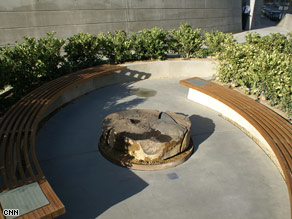
Healing Canada? ... Gardens? For whom? This CNN piece below has me thinking about 'healing'. What does it take to heal a nation from its own crimes of genocide? Certainly reminders ... public acknowledgment, commemoration ... Public gardens are appropriate for reflection ... but ... for whom?

Cathedral offers garden to sex abuse victims From Peter Ornstein CNN OAKLAND, California (CNN) -- Terrie Light stands outside Oakland's stunning new modern cathedral in a first-of-its-kind garden that honors victims of clergy sexual abuse. She was abused by a priest at age 7.
For the first time, the Catholic Church has offered a garden that honors victims of clergy sex abuse.For the first time, the Catholic Church has offered a garden that honors victims of clergy sex abuse.
"It's a really small, important physical representation of a horrific thing that happened in many places," she told CNN.She says the garden's centerpiece, a symbolic low stone sculpture that's broken, is fitting for those whose lives were shattered by priests. "The energy that the artist put was this circular stone trying to pull itself to become unbroken. That is our journey. That is what we try to do every day -- is to try to be unbroken."The garden is placed near a wall of the Cathedral of Christ the Light, which was consecrated September 25.Two low-curved benches bracket the sculpture, one facing toward the cathedral, the other facing away. The benches are surrounded by hedges. Video Watch the bishop of Oakland apologize to victims »The bench placement is deliberate and takes into account the feelings and needs of abuse victims.Those who choose not to face the cathedral end up facing a small lake across the street.Father Paul Minnihan, the provost of the cathedral, says it was important to have the garden -- for the victims, and for the church to atone for the sins of its past."Part of the church's mission is to make sure we bring healing to people who are in need of it, even if we were the cause of it," he says. "Having this garden on the campus says we are serious about our desire to help in your healing process on whatever level. As this cathedral will be around for 500 years, so will that garden as a place of healing and hope."
Nowhere is it even suggested that the guilty church institutions and the church members who sustain them without proper oversight would also benefit from the reminder, from use of the garden to humbly reflect on the misdeeds of the church. Perhaps a noble gesture ... or perhaps just more patronization? Isn't the church the broken one in need of healing? Back to Canada ... 'Indian' Residential Schools ... Children who suffered ... Children who died ...

While many community leaders, including elders and a former United Church minister, have spoken of unmarked graves on the sites of residential schools before, this is the first time federal researchers have attempted to compile documentary evidence as to the extent of these discoveries.

The material obtained by The Globe and Mail was completed by two researchers at Indian Residential Schools Resolutions Canada.

Their findings, submitted in an April, 2008, report, reveal several schools had cemeteries on school grounds.

The reason for the placement of cemeteries on the school grounds is not given in the research documents. But in the case of two schools in particular, the researchers found detailed documents describing graves without markings.

Graves without markings, at the residential schools ... How many died? ... Why? Why were their families never informed? Children who escaped ... Did they survive? Some did ...

2003 Grassy Narrows ON: CLEARCUT DEFIANCE

http://www.montrealmirror.com/ARCHIVES/2003/032703/news3.html

Another warrior, Charlie, 48, has a soft and slow voice that can be difficult to follow, but his stories are worth the effort. He was put in residential school at the age of seven and escaped several times, each time getting sent to a school further from home. Four years and six escapes later [1966], he was in a school near Sault Ste-Marie, where the nuns beat him unconscious with hockey sticks. He still has the scars.

"I knew that if I stayed, they'd kill me, so I escaped again. I made it to Winnipeg [1,450 kilometres away] on foot through the bush, living off the land, fooling the police dogs in the woods. They didn't catch me that time until I was 21," he says. The other men his age have similar residential school stories. Nothing can happen to them in jail or in a gunfight that's worse than what already has.

And some did not survive the escape ...
https://lists.mayfirst.org/pipermail/bearwithoutborders/2007-December/001594.html

But I wonder: How much will Canada pay for Joey Commanda, walking in fear along an isolated stretch of train tracks, shuffling his way homewards hundreds of miles in the distance, wishing his Akwesasne pals were there to show him the way. Maybe the lawyers can chip in and buy him a decent memorial. Or perhaps, they can stop the rumbling train in my mind before it hits Joey and drives his nearby brother Rocky insane.

And some are still finding ways to survive ...
http://cfar.proboards104.com/index.cgi?board=discuss&action=display&thread=166&page=1#563 For the participants of today's rally, just confronting the church without fear was enough of a victory. "It made me happy for the first time in a long time, you know?" said an older survivor from the downtown eastside. "Did you see the way even the cops stood back and didn't stop us? I didn't get scared when I saw them show up. Not even that f ... ing priest scared me. I guess being here all together like this was like, the start of our healing."
I believe in public gardens to commemorate the children who suffered and the children who died in, or because of, Canada's 'Indian' Residential Schools. I believe it would help to inform Canadians, because we cannot begin to heal until we know the truth, a place to pause and reflect on our responsibility to oversee the work of our governments and institutions, to be sure that in working in our interests they are never again infringing on the rights and lives of others ... never again taking children from their parents and their ways, only to abandon them to unmarked graves ... thousands of graves ... all across Canada.
All that is necessary for evil to triumph is that good men do nothing.
- attributed to Edmund Burke
So far, this is the history of Canada ... evil flourishing against Aboriginal People ... children ... while we Canadians did nothing to stop it. A garden ? ... well ... it's a small beginning.

Wednesday, October 29, 2008

Who, Us? Be Truthful and Reconciling? Some Pastoral Reflections on and for my Sick People

by Rev. Kevin Annett

www.hiddenfromhistory.org

The whole sorry and self-serving charade called Canada's "Truth and Reconciliation Commission" into Indian Residential Schools is exactly like a sexually abusive parent calling all his family together to discuss why everyone seems so troubled and hurt ... without, of course, ever looking at his own behaviour, or surrendering his tyranny over them. When the abuser runs the show, whose truth will be allowed? And who, and what, can possibly be "reconciled"? If you'll allow me for a moment to push this analogy, here's the answer: the only truth allowed in such an abusive family system is whatever doesn't upset the arrangements of abuse - and everyone involved must be "reconciled" to that fact. Having dealt with many such situations at the family level, I am amazed at how similar is our condition in the much larger family called Canada, as we gather now at the behest of those responsible for our suffering to be told that it's time to look into why we have suffered. The institutions of church and state that planned and carried out conquest and murder have declared that the truth of what they did will now be told, in a self-appointed inquiry called a truth and reconciliation commission, or "TRC". (Gee, the letters almost form the word "trick"). Like the raping and brutal parent who has called his family together to "share", those who have suffered from his blows will not be allowed to speak of what he has actually done to them. The TRC public forums will not permit residential school survivors to name the names of their torturers, or even discuss "wrongdoing" in the schools. Nor will they be legally protected from the consequences of anything they say. In short, a simple message to survivors: Watch what you say, or you'll get whacked again. If a rapist posing as a parent tried that, his deception would be obvious, but only to those outside his family system of dysfunction and fear. To those quivering under his rule, his hypocrisy would seem generous and inspiring, a sign that perhaps he is changing and will stop beating and raping them. The big problem in Canada is that most of us, native or white, are part of the quivering mass who have grown up under the absolute rule of colonial church and state. We cannot stand outside the dysfunction called Christian Canada and see the lies for what they are. But in any abusive situation, there are those who are able to see their torture for what it is, and seek help in confronting the Big Rapist: not easily, or quickly, but through courage, reason, and thinking outside their family system, as well as by their the capacity to suffer the outrage of all their fellow abused, quivering family members. From the beginning of the whole debate around "truth and reconciliation", no-one in "authority", and few outside it, have asked the most obvious and fundamental question:

Are we, as a nation, capable of either truth or reconciliation? Did truthfulness or the desire to be reconciled at any point guide the policies and actions of the Canadian government or its Anglican, Catholic and United churches towards native people? Was it truthful or reconciling to house the sick with the healthy in residential schools, and stand by as thousands of children were killed off over a century? Or, to suppress the evidence of this crime by secretly burying or burning up the dead, and incinerating documents, and silencing witnesses? Or, to allow the churches responsible for these crimes to evade prosecution and set up the TRC inquiry into what they did? Even today, is a desire for truth guiding the TRC, when it is muzzling what survivors can say at the behest of church lawyers - and when it has declared that, even though criminal acts and homicide occurred in the residential schools, there will be no criminal investigation into these schools? Protecting the perpetrators and minimizing the cost of the whole thing: those are the two fundamental purposes of the TRC, and its government and church backers: not seeking "truth and reconciliation". After all, truth is a pretty simple thing to do: you just let people talk, freely and openly. You disclose what you know and surrender the guilty. You disinter graves and give the murdered a proper burial, tell the whole sordid history, and create memorials and museums to honour the dead. And most of all, you stop doing the crime. Maybe, after generations of such truthful action, "reconciliation" may be possible. But that's not in our hands. The truth is, none of these basic things are happening in Canada. Everything related to the residential schools is being carefully managed so that the churches will not have to suffer anything, or be held accountable for their murder of children, and no political fallout will beset the government. Once these primary abusers are protected, then sure, we'll be able to have all the "truth and reconciliation" we want: all that is due anyone in an abusive family. And then "justice" will have been done - on the terms of the abuser, of course. Is there another way? There is, actually, but it probably won't happen - for it begins with us, "white" Canada, looking at ourselves honestly, and healing ourselves first - like any abuser must do if genuine peace and health is to return to his family. The town pedophile always hides behind a veneer of liberal humanitarianism, and Canada is no different. Canada was built on murder and conquest, and sustains itself by raping the land of its resources as quickly as our foreign corporate rulers dictate. That's never changed. And native people are simply in the way of that huge grab, as they always were, which is why they are being killed off at nearly the same rate they were a century ago. Most of this isn't obvious to the sheltered "white" citizenry, who get along with and sustain the Big Rapist by paying their taxes, doing their jobs, and believing the Family Lie. And so they won't be convinced about who and what they are very easily, not this side of their cozy world collapsing. Of course, it is collapsing, and quickly. All the raped resources can't last forever. When we've outlived our usefulness to GoldCorp and Teck Cominco and Power Corporation, and to the United States government, we'll be tossed aside and watch as all the stuff on which we base our optimistic view of ourselves vanishes - watch, indeed, as our air and lakes and rivers finally die, and we finally learn that it wasn't just little Indian kids that we were murdering in the residential schools. Those scientists who aren't on the corporate and government leash - and there aren't many - believe that we're actually past the point of no return when it comes to planetary survival, and that ours could very well be one of the last generations of humanity - let alone life - on mother earth. So let's stop pretending that we, as a people, can heal, be truthful, or be reconciled, about anything. Clearly, we can't - not about our own history and nature, at least. And when death approaches, all that is needed is telling it like it is. Death is approaching, because of us - because of the rapacious greed of European culture, its corporate capitalism spawned by a Christian imperialism that said we had and have the right to conquer anything, and anyone. We are all now the victims of our very civilization, which is destroying us and our perfect planet. The horror we unleashed in the Indian residential schools was just one manifestation of that sickness. So it's time for all that to end, as it should. We will never stop our depredations, our crimes, our cozy rationalizations and arrangements - so that's all being ended for us. My answer to my fellow Canadians, and its absurd "Truth and Reconciliation Commission", is this: Stop trying to be what you're not. We are neither truthful nor reconciling. We are a culture and a people of the Lie, a conquering, arrogant culture that will surrender nothing, regardless of the individual exceptions to that rule. Here, instead, is what we need in Canada - something much more in line with our true nature: An Irreconcilable Untruth Commission, which openly declares this to our aboriginal victims: Yes, we conquered this land and its indigenous people, because we wanted your lands and resources. We did what we had to do to steal this land, and we will not surrender any of it to you, the survivors of our conquest. Sure, we'll grant you Indians crumbs now and then, especially to the few among you we've trained to be our loyal servants. But the rest of you are expected to die off quietly and to help us terminate you. In the meantime, to keep everything in our hands and sustain our international reputation and credit rating, we'll admit to some things. Of course we killed off children in the residential schools. How else were we supposed to destroy your hold on the land and yourselves, once and for all? How else were we supposed to so traumatize you that you'd not fight us and would sink into the oblivion of poverty and self-destruction? How else would you come to love competition and murder and shopping and self-gain? Get real. That's how our world operates. It's called western civilization. If only we Canadians had the clarity and the courage to know this, and to speak thus. But we don't, which is why the "Truth and Reconciliation Commission" will carry on, spreading the reality that makes us feel most comfortable and reassured. It's all about us, after all. The ones who matter. May we rest in peace. ......................................................................................................... October 28, 2008 Samhain - Celtic Season of Change and Transformation Kevin D. Annett, M.A., M.Div. 260 Kennedy St. Nanaimo, B.C. V9R 2H8 Canada 250-753-3345 or 1-888-265-1007 “Kevin is more deserving of the Nobel Peace Prize than many who have received it in the past.” - Dr. Noam Chomsky Institute Professor Emeritus Massachusetts Institute of Technology “A courageous and inspiring man." (referring to Kevin Annett) - Mairead Corrigan-Maguire Nobel Peace Prize Laureate Belfast , Northern Ireland The very lands we all along enjoyed they ravished from the people they destroyed ... All the long pretenses of descent are shams of right to prop up government. ' Tis all invasion, usurpation all; ' Tis all by fraud and force that we possess, and length of time can make no crime the less; Religion's always on the strongest side. Daniel Defoe, Jure Divino (England, 1706)

Tuesday, October 28, 2008

Missing Children Task Force... Canada's 'Indian' Residential Schools

http://thetyee.ca/Books/2007/08/08/Mothers/

Emma Crosby and Margaret Butcher shared an unquestioned assumption that white Christians had the right and duty to tear native families apart, to deprive children of their own cultures, and to impose Victorian sexual values on them. ... This arrogation of control over their converts' lives seems to have blinded the missionaries to the harm they were doing, so they could shrug off the natives' death and suffering as just the price to be paid for progress.

http://www.theglobeandmail.com/servlet/story/RTGAM.20081027.wgraves28/BNStory/National/?page=rss&id=RTGAM.20081027.wgraves28

GLobe and Mail article

Commission to probe graves at school sites

BILL CURRY AND JOE FRIESEN

From Tuesday's Globe and Mail

October 27, 2008 at 8:01 PM EDT

OTTAWA and TORONTO — The commission examining Indian residential schools is launching a massive new research project to find out who is buried on school grounds and what happened to the young aboriginal boys and girls who left for boarding schools and never returned home.

Kimberly Phillips, a spokesperson for Canada's Truth and Reconciliation Commission, said the expanded research has been approved by Claudette Dumont-Smith, one of the commissioners.

The “Missing Children Research Project,” as it has been named, will include “an examination of the number and cause of deaths, illnesses and disappearances of children at the residential schools as well as the location of burial sites,” Ms. Phillips said.

Ms. Phillips said researchers will go through all relevant church and federal government records to find information that will help families looking for lost children. They will also prepare a questionnaire, and encourage former students and people who worked at the schools to come forward with their stories.

Snow falls on gravesites in the Wabasca Cemetery.
Enlarge Image

Snow falls on gravesites in the Wabasca Cemetery. (Ken Armstrong for The Globe and Mail)

Related Articles
The Globe and Mail

The commission's plans also suggest possible options for honouring the spirit of those who died.

According to a commission document obtained by The Globe and Mail, one option involves “visiting residential school sites where graves of Missing Children are located or the cemeteries near the schools where Missing Children have been buried.”

Tuberculosis was the most common reason cited for deaths at schools across the country, however, survivors have said that rumours have circulated over the years that some of the forgotten children died of neglect, abuse or even murder.

The project is viewed internally as highly daunting, given the sheer volume of material available and number of former students willing to talk. It will build on preliminary research that The Globe reported on Monday.

That research confirmed that several residential schools had graveyards on site, that children at some schools were tasked with digging graves, and that some of those cemeteries were unmarked or had only anonymous white crosses.

AFN national chief Phil Fontaine said through his lawyer yesterday that the documents featured in The Globe underscore the need for a commission to continue gathering the complete history of residential schools.

“This is the very kind of issue that needs to be raised,” John Phillips said. “It's the reason the Truth and Reconciliation Commission was created.”

That view was echoed by Mike Cachagee, who says he buried the first of four classmates when he was eight years old at Saint John's Indian Residential School in Chapleau, Ont., and then at Moose Factory Indian Residential School in Moose Factory, Ont.

He said he was told the children died of tuberculosis.

Mr. Cachagee, who chairs the National Residential School Survivors' Society, said former students want these graves identified so they can better understand their family histories.

“We can't just have our people planted in the ground and forgotten about,” he said. “That's basically what they did.”

The missing children project has been given the green light as a key meeting is scheduled for Wednesday in Toronto to sort out the controversy over the surprise resignation of commission chairman Mr. Justice Harry LaForme and to map a way forward.

Mr. Phillips will represent the AFN, and lawyers for the federal government, churches and former students will also attend.

There are many differences of opinion heading into the meeting. The federal government wants a legal clarification of the role and powers of the three commissioners. In his resignation letter, Judge LaForme had said there was disagreement over whether the chairman can overrule the two commissioners or whether the three individuals must operate on consensus or majority rule.

Judge LaForme has also claimed that the two other commissioners disagreed with his view that reconciliation should take precedence over digging up truth from the past.

A source close to the process said one of the principal questions to be addressed is whether commissioners Jane Brewin Morley and Ms. Dumont-Smith should be replaced, in light of Justice LaForme's acrimonious departure.

“You'd have to be crazy to step into the remnants of such a dysfunctional situation,” the source said.

Monday, October 27, 2008

Hunt begins for long-missing students

Neglected graves probed in renewed effort to solve mystery of aboriginal children's fates

From Monday's Globe and Mail

OTTAWA — The federal government is mapping burial sites at former residential schools as researchers try to identify how many of the estimated thousands of native children who went missing from the schools are buried in unmarked or anonymous graves.

Cemeteries scattered across Alberta, Saskatchewan, Manitoba and Ontario have been identified by researchers. Some of the graves have single white wooden crosses bearing no name. Others do not include even a cross.

The Truth and Reconciliation Commission asked for the material before its head, Mr. Justice Harry LaForme, resigned unexpectedly last week after accusing the two other commissioners of being too focused on the commission's mandate to uncover truth about residential schools, at the expense of reconciliation.

Cemetery research is part of an attempt by the federal government to understand precisely what happened to the residential school students who disappeared.

It is a massive and sensitive issue. Native leaders and successive federal governments have said they simply do not know who or how many students of the residential schools even died, never mind where they might be buried.

While many community leaders, including elders and a former United Church minister, have spoken of unmarked graves on the sites of residential schools before, this is the first time federal researchers have attempted to compile documentary evidence as to the extent of these discoveries.

The material obtained by The Globe and Mail was completed by two researchers at Indian Residential Schools Resolutions Canada.

Their findings, submitted in an April, 2008, report, reveal several schools had cemeteries on school grounds.

The reason for the placement of cemeteries on the school grounds is not given in the research documents. But in the case of two schools in particular, the researchers found detailed documents describing graves without markings.

Indian Affairs documents reveal bodies were accidentally unearthed in 1992 on the grounds of the former Muskowekwan Indian Residential School in Lestock, Sask., which was run by Catholic missionaries. The graves were uncovered during a construction project to build a new sewer line on the property.

"On July 21, 1992, workers with N.I.S. Construction Ltd. uncovered three unmarked graves," the Indian Affairs document states. "On July 22, an additional 15 graves were encountered. They were located in a row paralleling the new gravity sewer main north of residence 0210-01. The contractor indicated there was evidence of another row of graves north of the first row encountered ... All remains unearthed were placed in plastic bags and stored in a locked building."

The document says the local band council was then notified and construction was halted. The band manager for Muskowekwan First Nation declined comment for this story, as did the manager of the youth centre now operating in the former residential school.

At another school, the St. John's Indian Residential School in Alberta (also known as Wabasca Residential School), the researchers found a document from 1961 describing how the principal came across an unmarked cemetery. A second letter indicates the unidentified principal ultimately cleaned up the site and erected 110 white crosses.

"The place was a terrible mess, so much underbrush," according to one of the letters. "Even though it is not finished, one can see a great improvement in it all, at least it is not woods now."

Anglican priest Richard Waye has been serving the Cree community of Wabasca for the past nine years. He said the community's large graveyard dates back to 1895 and is well maintained by the community, including support from the Big Stone Cree Nation. Rev. Waye said old crosses are replaced with new ones.

"I've never heard anything like that," he said when told of the 1961 entry by the principal. "If it ever happened that the cemetery had come into disrepair, I don't think that it would have been because of any lack of respect. ... Everything here is well maintained and it's respectful."

Rev. Waye said "99.9" per cent of the people attending his masses are Crees with ties to the residential school.

"My impression is that people still attend the church because of the positive experience they had as children in St. John's school," he said.

Detailed records related to the Edmonton Indian Residential School include a principal's letter from 1955, stating: "Some years ago the Indian Affairs branch asked for room on the property ... for a small graveyard in which to bury deceased Indians and Eskimos from Camsell Hospital whose homes are too far in the North to return the bodies for burial. The boys at the School keep the ground in reasonable condition for no remuneration but they get paid for digging graves."

Another reference to a document from 1945 suggests the Alberta Blood band council was aware of a cemetery at the Blood Indian Residential School (also known as St. Mary's), and wanted the graves dug deeper to prevent "effluvia" near the girls' playground

The researchers found a comment on the issue from the federal Indian Agent, stating: "While it is appreciated that in Winter particularly, it is difficult to get the Indians to do the work suitably, may we ask that this request be placed before the Indians when digging Graves."

The day after a Globe and Mail investigation reported in April, 2007, on the fact that thousands of native children likely died at Indian Residential Schools due to diseases like tuberculosis and possible neglect, the Conservative government promised to investigate.

"It is unimaginable to any parent that your child would go away to school and not return," then-Indian Affairs minister Jim Prentice said

at the time, announcing that the mandate of the Truth

Source: Assembly of First Nations

and Reconciliation Commission would be expanded to include an investigation of unmarked graves and missing children.

But a separate paper dated September, 2008, suggests that approach was not the government's first instinct. Bob Watts, the commission's former executive director, who no longer works at the commission, wrote that Mr. Prentice was planning to tell the House of Commons, if asked about it during Question Period, that it had no information about the issue of "Missing Children and Unmarked Burials."

"I wrote back the author of the [Question Period] card, and asked whether or not this was true," Mr. Watts wrote. He then describes how a meeting was then hastily called and a decision was made to form a working group to study the matter and provide advice to the commissioners.

Mr. Watts then writes that Mr. Prentice's office was a "model of non-interference" as the working group began its research.

When The Globe requested all documents related to this working group, the government provided a highlyredacted version of a briefing note on the issue.

The Globe has also obtained a draft version of the non-redacted document.

It is a research paper into missing children and asks that the Truth and Reconciliation Commission undertake to discover how many residential students died and who they were, what they died from and where they are buried.

Native elders have for decades provided anecdotal evidence that schoolchildren died and their fellow students were forced to bury them.

The issue of unmarked graves was not specifically explored by the 1996 Royal Commission on Aboriginal Peoples. That report recommended an independent public inquiry be called to examine the effects of residential schools.

The boarding schools were part of an overall federal policy started in the first years of Canada's founding to assimilate aboriginals into the increasingly dominant population of European immigrants.

Partnering with churches that were already established throughout Canada as part of their missionary work, Ottawa built the residential schools and paid churches on a per capita basis to take in native children and teach them a mix of agricultural skills and traditional schooling.

*****

Buried, not forgotten

1. St. John's

Indian Residential School

Wabasca, Alta.

Anglican

Also known as Wabasca

Residential School

opened 1895; new school built in 1949; closed 1966

The IRSC report quotes a 1961 letter from an unidentified school principal who describes a cemetery with unmarked graves that is "a terrible mess." A letter written three weeks later states that the cemetery has been cleaned up and 110 white crosses erected. The school is no longer standing, but the current Anglican minister in Wabasca says the cemetery is well cared for and he had not heard of any historical problems regarding maintenance.

2. Edmonton

Industrial School

St. Albert, Alta.

Methodist

opened 1919; closed 1960s

The IRSRC report states that boys at the school were paid to dig graves at the area cemetery. A committee of historians wrote a letter to the Northwest Territories government in 1989 requesting funding for a memorial to recognize the 98 Inuit and Indian people lying in a small cemetery on the grounds of what was the residential school. Advocates for a monument wrote letters to government and church leaders stating that the cemetery grounds had not been cared for since the school closed.

3. Immaculate Conception Boarding School

Standoff (Cardston), Alta.

Roman Catholic

Also known as Blood Indian Residential School; St. Mary's Mission Boarding School

opened 1911; closed 1975

The IRSC report makes reference to a 1945 letter describing how it is "difficult to get the Indians to do the work suitably" when digging graves in winter at the school. The letter indicates that the Blood Band council was aware of this activity.

4. Muskowekwan

Indian Residential School

Lestock, Sask.

Roman Catholic

opened 1896; closed 1981

An Indian Residential Schools Resolution Canada (IRSRC) report reviewing Indian Affairs documents describes an incident in 1992, when a construction company uncovered at least 19 graves connected to an unmarked graveyard at the site of the former school. Muskowekwan Indian Residential School is still standing and is on land managed by the Muskowekwan First Nation band council. It is now home to a youth services centre. Compiled by Rick Cash and Bill Curry, using information from the IRSC report as well as the Anglican Church of Canada and the Assembly of First Nations.

**********

More info on residential school deaths here ...

http://www.esnips.com/doc/f401fa83-7af5-4ca5-920f-81f0a2a6f27f/The-Facts-of-Deliberate-Genocide-of-Aboriginal-People-in-Canada

Interview - Friends and Relatives of the Disappeared ...

http://www.isuma.tv/?site/channelHome/channelid/238

Previous articles by Bill Curry, Globe and Mail:

http://tinyurl.com/6j5x8n More blogs by granny ... (See interview with Kevin Annett) Truth? Reconciliation? http://residentialschooldeaths.blogspot.com

Saturday, October 25, 2008

Regarding the resignation of Judge Harry LaForme as chairman of the Truth and Reconciliation Commission ...

No room for aboriginal politicking

Posted 2 hours ago

Regarding the resignation of Judge Harry LaForme as chairman of the Truth and Reconciliation Commission:

Is there no end to the shame the survivors of Indian residential schools must endure? On the basis of events unfolding this week at the Truth and Reconciliation Commission, it would appear not.

Judge Harry LaForme’s decision to step down as chairman in the face of interference from the Assembly of First Nations was the right thing to do. In so doing, Judge LaForme demonstrates the degree of integrity of which residential schools survivors are so deserving.

This commission was intended to be the cornerstone of the Indian Residential Schools Settlement Agreement. Its aim was to play a vital role in the ongoing healing process by providing former students the chance to share their experiences. It was also mandated to educate all Canadians about the Indian residential schools system and the impacts this system has had on aboriginal people and their communities. It was to serve as an opportunity to focus on former students who are moving forward and making a positive difference in their lives, and in the lives of people around them.

Justice LaForme was unanimously chosen as chair from a pool of more than 300 applicants. The selection panel included representatives of national aboriginal organizations and other parties to the Settlement Agreement.

The Truth and Reconciliation Commission should serve as way forward to get beyond the impacts past political decisions have had on First Nations peoples, families and communities. How sad it is that current machinations in aboriginal politics appear to have derailed a body with so noble an intended purpose.

It is time the other two commissioners and the national chief of the Assembly of First Nations come forward in a spirit of honesty and contrition and explain their actions to the survivors of Indian residential schools. Our peoples deserve no less.

It is time the aboriginal community agree to embrace a truly impartial and arm’s-length body that will enable the commission’s objectives to be achieved without interference and completely free from the partisan positions of any aboriginal organization or government body.

It is also time we, as an aboriginal community, take full ownership of our failings in this instance. Immediate and sincere steps must be taken to right this very evident wrong. We have let our own people down in permitting the types of interference by aboriginal groups that have resulted in Judge LaForme’s resignation.

We, as a community, had full opportunity to get it right the first time — and we have failed. The commission must be reconstituted immediately under the auspices and oversight of the courts. Only then can we ensure justice is served, not in the interests of aboriginal politicians, but solely and humbly in the interests of the survivors who have been subjected to further and needless pain, suffering and indifference.

National Chief Patrick Brazeau

Congress of Aboriginal Peoples

editor@cpheraldleader.com

http://www.cpheraldleader.com/ArticleDisplay.aspx?e=1264750 ... and ...

/R E P E A T -- Churches Express Confidence in Truth and Reconciliation Commissioners/

http://www.cnw.ca/fr/releases/archive/October2008/24/c9194.html
The ones with things to hide are primarily churches, government and RCMP, and the AFN seems to follow their agenda. It isn't surprising that the churches support the Commissioners who squeezed Judge Laforme out. The churches and other perpetrators prefer a more controlled Commission, not an independent one. The fact that the government has called a meeting with the AFN and churches is just them resuming the reins of power over the Commission and does not bode well.

Friday, October 24, 2008

Film: UNREPENTANT Canada! ... WHERE ARE THE MISSING CHILDREN? ...
Kevin Annett's appearances unfortunately cancelled due to his health. Screening of "Unrepentant" will go on at Skydragon Centre Tues Oct 28 @ 7pm. granny
...
Indigenous Elders in Canada ask: “Where are our missing children?”

Award winning documentary film

UNREPENTANT:

Kevin Annett and Canada's Genocide.

Kevin Annett joins us at Skydragon Centre Tuesday October 28 at 7 pm 27 King William St Hamilton, ON, Canada (905) 777-8102 (1blk n&e of James and King)
Over 50,000 children did not come home from Canada's 'Indian' Residential Schools. Their families were never told what happened to them. Thousands of graves are unmarked in the schoolyards. Thousands of children were systematically abused, tortured and broken, And thousands of Indigenous children died in the care of the government and the churches, for a hundred years, unaccounted for. Canada! ... WHERE ARE THE MISSING CHILDREN? Why?
http://residentialschooldeaths.blogspot.com/2008/10/unrepentant-where-are-missing-children.html#links TRUE Wednesday October 29, Brantford Six Nations, Brantford: What about Eagle Place? http://grannyrantson.blogspot.com/2008/10/blog-post.html

Record beyond reproach

Toronto -- Justice Harry LaForme's resignation as chair of the Indian Residential Schools Truth and Reconciliation Commission is truly a troubling event (Native Leaders Divided Over Future Of Residential Schools Panel - Oct. 22). More troubling is the unhelpful comments of some leaders of the aboriginal community.

Bill Wuttunee suggested that Judge LaForme was less than qualified for the position. He then asked if Judge LaForme had "the enthusiasm to work in that position or was he too lazy?"

Suggestions that Judge LaForme is unqualified or lazy could not further miss the mark. His appointment was met with universal acclaim. His work ethic during his accomplished career speaks for itself.

The judge's resignation is telling. I am certain it was a decision he agonized over and only reached due to the impossibility of the situation in which he found himself.

...

Judicial independence key to LaForme's resignation

From Friday's Globe and Mail

As Mr. Justice Harry LaForme agonized over whether to stay on as chairman of the Indian Residential Schools Truth and Reconciliation Commission, he was faced with the question of whether he wanted to spend five years fighting for his own independence and authority.

The 61-year-old Ontario Court of Appeal judge consulted commission counsel Owen Young, whom Judge LaForme had stood by despite the opposition of some native groups to his hiring.

Mr. Young tried to persuade Judge LaForme, the country's highest-ranking aboriginal judge, to stay. “Harry, the country needs you,” he said.

“We're not giving up this fight for reconciliation,” the judge replied. “But we're going to have to move to another context.”

An intermediary explored the possibility that Jane Brewin Morley and Claudette Dumont-Smith, the two commissioners who opposed Judge LaForme, might resign to break the deadlock, but they said they would not.

“He did the thing that he could control, let me put it that way,” Mr. Young said. “He could have asked them to leave; they wouldn't leave.”

His resignation Monday caught many by surprise. Attempts at conciliation had been launched at the behest of Ontario Chief Justice Warren Winkler, led by Toronto lawyer Will McDowell. People close to the discussion felt that, given time, solutions could have been found to the issues that divided the three: whether there was a hierarchy in the group, whether decisions would be made by consensus, whether the commission would focus on truth or reconciliation or both, and how close the commission would be to the parties to the court-supervised settlement of lawsuits over the schools. Creation of the commission was a cornerstone of that agreement.

The three commissioners met with Mr. McDowell on Sept. 30 in Toronto.

Judge LaForme was still frustrated by the other two commissioners' trip to Ottawa four days earlier at the request of the Assembly of First Nations to meet with the parties to the settlement. He had said he wouldn't go, and recommended the two commissioners do the same.

The judge said that decision was based on the need to defend judicial independence. He believed the commission had to be sympathetic to the survivors, but couldn't be seen to be captive to the AFN, according to a source close to the commission.

In an interview with The Globe and Mail two weeks ago, Judge LaForme gave no hint of what he later called the “incurable problem,” but chose to emphasize the importance of independence.

“My view of independence is such that I would defend it as strongly against the government of Canada as I would against any political organization or any church,” he said.

http://www.theglobeandmail.com/servlet/story/RTGAM.20081023.wCommission24/BNStory/National/?page=rss&id=RTGAM.20081023.wCommission24 ... more... http://www.canada.com/vancouversun/news/editorial/story.html?id=d1bcdf18-72ce-4b3c-9499-baf51c98d404 http://www.canada.com/edmontonjournal/news/opinion/story.html?id=522a7485-45c3-49d2-8416-7d9f72e8f5e0 TheStar.com - Canada - Native leader wants to know why judge quit
October 24, 2008
Nicole Baute Staff reporter
The chief of the Congress of Aboriginal Peoples is demanding answers from the Truth and Reconciliation Commission following the resignation of Justice Harry LaForme earlier this week over differences among commission members. Patrick Brazeau's remarks came after commission counsel Owen Young said in a published report that LaForme quit because the Assembly of First Nations was interfering with the commission's independence. Young said he was speaking on LaForme's behalf. Brazeau said Canadians deserve to know more. "How far was the political interference, and what exactly was the political interference?" Brazeau said yesterday. "Nobody knows. "We want to know the truth." Phil Fontaine, national chief of the Assembly of First Nations, responded earlier that the assembly was meant to play a central role in a settlement agreement. The $60 million commission was established June 1 as part of a class-action settlement for the government-funded Indian residential school system, in which many Aboriginal students endured physical, emotional and sexual abuse.
My Canada includes rights of Indigenous Peoples.
LOVE IT OR LEAVE IT!
Peace.

Two Row Wampum Treaty

Two Row Wampum Treaty
"It is said that, each nation shall stay in their own vessels, and travel the river side by side. Further, it is said, that neither nation will try to steer the vessel of the other." This is a treaty among Indigenous Nations, and with Canada. This is the true nature of our relationships with Indigenous Nations of 'Kanata'.